
Bottled Water Market Poised for Strong Growth as Health Awareness and Premiumization Drive Global Demand
bottled water market
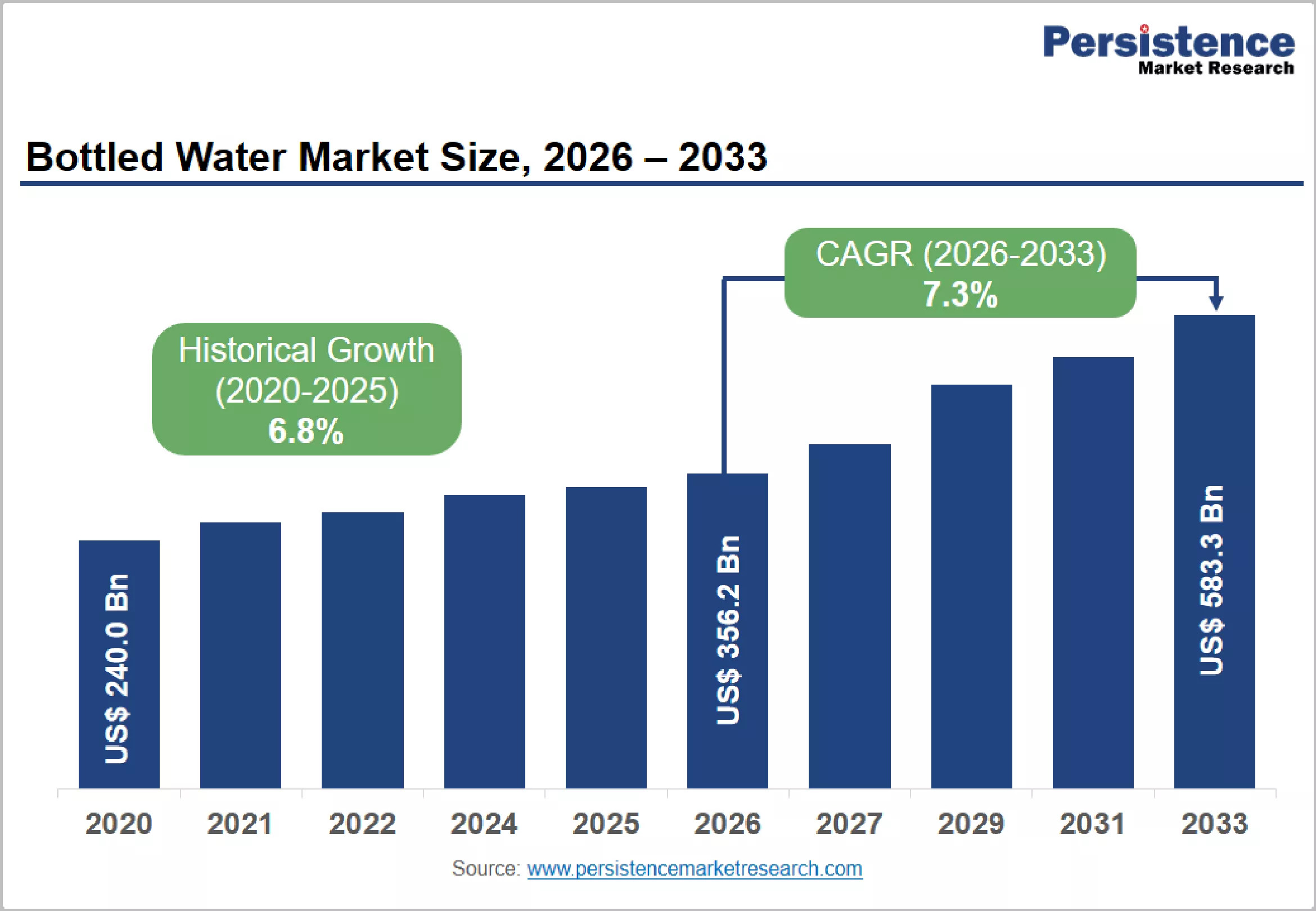
Global bottled water market to grow from US$356.2B in 2026 to US$583.3B by 2033 at 7.3% CAGR, driven by health trends and premium demand.
LONDON, UNITED KINGDOM, July 29, 2026 /EINPresswire.com/ -- The global bottled water market is set to witness robust expansion over the coming years as rising health consciousness, increasing concerns over drinking water quality, and rapid urbanization continue to reshape consumer preferences worldwide. According to industry estimates, the market is projected to grow from US$356.2 billion in 2026 to US$583.3 billion by 2033, registering a compound annual growth rate (CAGR) of 7.3% during the forecast period.
Growing demand for safe and convenient hydration solutions is transforming bottled water from a basic necessity into a premium lifestyle product. While emerging economies are driving volume growth through increasing access to packaged drinking water, developed markets are witnessing higher demand for functional and premium water products featuring added minerals, electrolytes, and wellness benefits.
Download Your Free Sample & Explore Key Insights: https://www.persistencemarketresearch.com/samples/32326
Health Awareness Continues to Fuel Market Expansion
Consumer preference for healthier beverage choices has emerged as one of the strongest drivers supporting bottled water sales globally. As awareness regarding the health risks associated with sugary drinks continues to increase, many consumers are replacing carbonated soft drinks with bottled water as their preferred daily beverage.
Health organizations worldwide continue to encourage water consumption as part of healthier lifestyles, contributing to consistent growth across both developed and developing markets. Rising disposable incomes and expanding middle-class populations in countries including India, China, and Southeast Asian nations are also encouraging first-time purchases of branded bottled water products.
The growing popularity of hydration-focused wellness trends has further strengthened demand for mineral water, purified water, sparkling water, and functional water varieties designed to support active lifestyles.
Urbanization and Water Safety Concerns Support Demand
Rapid urbanization remains another major factor accelerating bottled water consumption across emerging economies. Population growth and expanding cities are placing increasing pressure on existing municipal water infrastructure, creating sustained demand for packaged drinking water.
In many developing regions, bottled water serves as a reliable source of safe drinking water where access to treated municipal supplies remains limited. This trend is particularly evident across Asia Pacific, Africa, and Latin America, where growing urban populations continue to rely on affordable bottled water for everyday consumption.
As governments work to improve public water infrastructure, bottled water is expected to remain an essential solution for millions of consumers seeking dependable hydration.
Sustainability Challenges Reshape Industry Strategies
Despite strong market momentum, environmental concerns surrounding single-use plastic packaging remain a significant challenge for manufacturers. Governments across Europe and North America continue introducing stricter regulations aimed at reducing plastic waste and increasing recycled content in beverage packaging.
PET bottles continue to dominate the global market due to their affordability, lightweight nature, and efficient transportation advantages. However, manufacturers are increasingly investing in recycled PET materials, aluminum cans, glass bottles, and alternative packaging formats to meet evolving regulatory requirements and changing consumer expectations.
Companies are also strengthening sustainability initiatives by improving recycling programs, reducing packaging weight, and increasing transparency throughout their supply chains.
Get Custom Insights Designed for Your Business: https://www.persistencemarketresearch.com/request-customization/32326
Home Water Filtration Creates Competitive Pressure
The growing popularity of home water filtration systems is creating new competitive challenges for bottled water producers, particularly in developed economies. Consumers are increasingly adopting countertop filters, reverse osmosis systems, and smart purification technologies that offer long-term cost savings compared to repeated bottled water purchases.
As a result, many bottled water companies are shifting their focus toward premium mineral water, naturally sourced spring water, alkaline water, and functional hydration products that provide unique characteristics beyond purified drinking water.
This strategic repositioning is helping manufacturers maintain consumer interest despite growing competition from alternative hydration solutions.
Premium and Functional Water Create New Growth Opportunities
Premiumization has become one of the industry's most attractive growth opportunities. Consumers are increasingly willing to pay higher prices for bottled water offering superior purity, natural sourcing, enhanced mineral content, or additional health benefits.
Products featuring electrolytes, vitamins, alkaline properties, antioxidants, and sparkling formulations are attracting health-conscious consumers across North America and Europe. Luxury water brands are also strengthening their market presence through sustainable packaging, premium branding, and direct-to-consumer business models.
Industry analysts expect premium water to continue outperforming traditional bottled water categories as consumers increasingly associate hydration with overall wellness.
Market Segmentation
Product Type
Spring Water
Sparkling Water
Purified Water
Mineral Water
Others
Packaging Type
PET Bottles
Glass Bottles
Canned Water
Cartons
Others
Pack Size
Less than 500 mL
500 mL to 1 Liter
1 Liter to 2 Liters
2 Liters to 5 Liters
More than 5 Liters
Price Point
Mass
Premium
Luxury
Distribution Channel
Supermarkets & Hypermarkets
Convenience Stores
Grocery Stores
Online Retail
Foodservice & Hospitality
Vending Machines
Others
Region
North America
Europe
East Asia
South Asia & Oceania
Latin America
Middle East & Africa
Checkout Now & Download Complete Market Report: https://www.persistencemarketresearch.com/checkout/32326
Asia Pacific Maintains Market Leadership
Asia Pacific continues to lead the global bottled water market, accounting for approximately 44% of worldwide demand. The region benefits from its large population, rapid urbanization, rising health awareness, and increasing need for reliable drinking water across major economies including China, India, Indonesia, and Japan.
Meanwhile, the Middle East and Africa are forecast to record the fastest market growth through 2033 as urban expansion, population growth, and water scarcity continue driving dependence on packaged drinking water.
North America and Europe remain mature markets where innovation, premiumization, sustainability initiatives, and functional hydration products continue shaping competitive dynamics.
Competitive Landscape
The bottled water industry remains moderately consolidated, with multinational beverage companies maintaining strong positions alongside numerous regional and niche brands. Leading companies continue investing in sustainable packaging, premium product development, digital commerce, production capacity expansion, and direct-to-consumer delivery services to strengthen their competitive positions.
Read Related Reports:
Private Label Flour Market: Explore the Private Label Flour Market, projected to grow from US$8.9 billion in 2026 to US$12.4 billion by 2033 at a 4.8% CAGR.
South Africa Beer Market: The South Africa beer market is projected to reach US$ 16.6 Bn by 2033, growing at a 6.2% CAGR during 2026–2033, driven by rising consumer demand.
Persistence Market Research
Persistence Market Research Pvt Ltd
+1 646-878-6329
email us here
Visit us on social media:
LinkedIn
Instagram
Facebook
YouTube
X
Legal Disclaimer:
EIN Presswire provides this news content "as is" without warranty of any kind. We do not accept any responsibility or liability for the accuracy, content, images, videos, licenses, completeness, legality, or reliability of the information contained in this article. If you have any complaints or copyright issues related to this article, kindly contact the author above.
