

Get your daily news on healthcare and wellness
Provided by AGP
Global Agrochemicals Market Set to Reach USD 406.2 Billion by 2034, Driven by Rising Food Security Demands
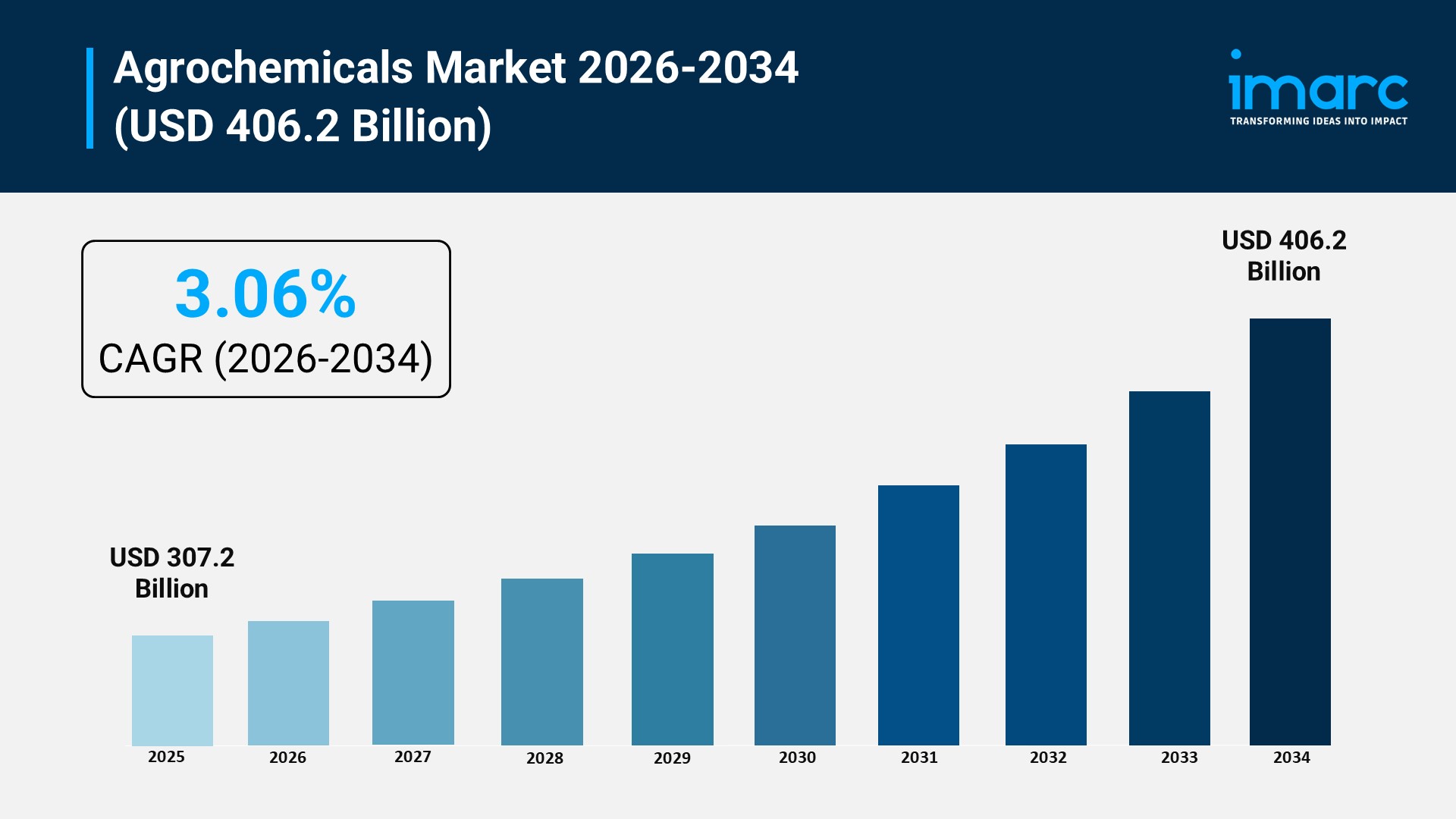
Agrochemicals Market Graph 2026
IMARC Group's Latest Research Reveals a CAGR of 3.06% from 2026–2034, with Nitrogen Fertilizers and Herbicides Segments Leading Expansion
SHERIDAN, WY, UNITED STATES, May 13, 2026 /EINPresswire.com/ -- The global agrochemicals market has reached a pivotal inflection point as population growth, shrinking arable land, and climate-driven pest pressures converge to accelerate demand for advanced crop protection and nutrient delivery solutions. According to a comprehensive new report by IMARC Group, the global agrochemical market size was valued at USD 307.2 Billion in 2025 and is projected to reach USD 406.2 Billion by 2034, expanding at a CAGR of 3.06% during 2026–2034.The scale of the opportunity reflects a fundamental reality: worldwide usage of agrochemicals currently drives a 30–50% increase in agricultural productivity, enabling farmers to sustain food production despite accelerating urbanization and declining farmland availability. With the global population projected to reach 10.3 billion by the mid-2080s, the agrochemical industry stands as one of the most critical enablers of global food security.
Request for a sample to get detailed understanding about the market: https://www.imarcgroup.com/agrochemicals-market/requestsample
What is Driving the Global Agrochemicals Market's Boom?
The report identifies three core forces reshaping the agrochemicals market's landscape:
• Increasing Concerns About Food Security: The global population trajectory demands a sustained increase in agricultural output from a shrinking base of cultivable land. Urbanization and industrial expansion continue to reduce farmland availability, making the efficient use of fertilizers and pesticides indispensable. Advanced formulations such as delayed-release fertilizers and biological pesticides now align with environmental objectives while boosting crop yields by 30–50% globally, according to industry data cited in the report.
• Rise in Adoption of High-Yielding Crop Varieties: High-yielding crop varieties (HYVs) have accounted for a 40% increase in global crop production from 1965 to 2010, according to the American Council on Science and Health. However, these varieties are often more susceptible to pests and diseases, directly increasing dependence on insecticides, fungicides, and herbicides. The global consumption of nitrogen fertilizers has increased seven-fold over the past five decades alongside HYV cultivation, creating a structural demand floor for agrochemicals.
• Growing Need for Sustainable Farming Practices: Biopesticides and organic fertilizers, valued at USD 7.54 Billion in 2023, represent the fastest-growing subsegment as governments worldwide push for environmentally responsible agriculture. The EU Green Deal targets a 50% reduction in pesticide usage by 2030, opening significant opportunities for bio-based agrochemical alternatives. Corteva's hybrid wheat technology demonstrates the convergence of sustainability and productivity, delivering 10% yield gains without additional resource inputs and up to 20% greater yields in drought conditions.
Key Market Insights at a Glance
The following highlights the leading segments by category based on 2025 market share data:
• Fertilizer Type — Nitrogen Fertilizer: Largest segment, driven by its essential role in photosynthesis, protein synthesis, and cereal crop cultivation including wheat, maize, and rice.
• Pesticide Type — Herbicides: Largest segment, supported by widespread adoption of herbicide-tolerant GM crops and rising demand for efficient weed management across large-scale operations.
• Crop Type — Cereals and Grains: 47.02% market share, reflecting the dominant global cultivation of wheat, rice, and maize for human consumption and animal feed.
• Region — Asia Pacific: 43.2% market share, propelled by extensive arable land, high population density, and aggressive government investment in agricultural modernization.
• Country (within North America) — United States: 74.6% of the North American market, driven by advanced precision farming technologies adopted by 60% of large farms and significant R&D investment.
Detailed Segment Analysis
1. By Fertilizer Type: Nitrogen Fertilizer Dominates the Market
Nitrogen fertilizers command the largest share of the global agrochemicals market by fertilizer type, reflecting nitrogen's fundamental role in plant biology. As an essential component of chlorophyll, amino acids, and proteins, nitrogen directly determines photosynthetic efficiency and crop yield potential. The widespread cultivation of cereals such as wheat, maize, and rice, which require substantial nitrogen inputs throughout their growth cycles, ensures consistent, large-scale demand.
The segment encompasses key product forms including urea, ammonium nitrate, and ammonium sulfate, all of which are cost-effective and widely available across global supply chains. In September 2024, AdvanSix received a USD 12 million USDA grant to expand its ammonium sulfate fertilizer production under the SUSTAIN initiative, adding 200,000 tons of granular ammonium sulfate annually to meet growing demand for sulfur nutrition. Innovations such as slow-release and enhanced-efficiency formulations are further improving nitrogen use efficiency while reducing environmental impact, supported by government subsidies and food security programs worldwide.
Connect for detailed segmentation analysis, ask for analyst: https://www.imarcgroup.com/request?type=report&id=4315&flag=C
2. By Pesticide Type: Herbicides Lead the Market
Herbicides represent the largest segment within the pesticide type category, driven by their critical function in managing weed growth that competes with crops for nutrients, water, and sunlight. The segment's dominance is strongly reinforced by the widespread adoption of herbicide-tolerant genetically modified (GM) crops, which enable farmers to apply broad-spectrum herbicides without damaging their primary crop. This compatibility between seed technology and chemical inputs has created a self-reinforcing demand cycle.
Farmers across diverse geographies prefer herbicides for their capacity to reduce manual labor and lower operational costs, particularly in large-scale commercial farming operations. The availability of diverse formulations tailored for specific weed types and climatic conditions further broadens adoption. Technological advancements in precision spraying techniques are now improving application efficiency while minimizing environmental runoff. Fungicides and insecticides represent significant secondary segments, with the launch of products like Sipcam Agro USA's Mevalone biofungicide in 2024, featuring naturally derived active ingredients and Sustaine Technology for improved efficacy, illustrating the innovation pipeline in adjacent pesticide categories.
3. By Crop Type: Cereals and Grains Command 47.02% Share
Cereals and grains account for 47.02% of the global agrochemicals market in 2025, reflecting their unmatched importance to global food security and agricultural economies. Staple crops including wheat, rice, and maize dominate global cultivation, driven by high consumption rates for both human food and animal feed applications. These crops face persistent vulnerability to pests, diseases, and weeds, necessitating extensive and ongoing use of fertilizers and pesticides to maintain yields.
The segment benefits from significant technological advancements, including high-yield seed varieties and targeted agrochemical solutions engineered to protect cereals from both biotic and abiotic stressors. Government programs aimed at boosting food production, especially in regions with rapid population growth, continue to reinforce the segment's dominant position. The growing adoption of modern farming techniques, including precision agriculture and integrated pest management, highlights the expanding role of agrochemical solutions in ensuring consistent cereal and grain productivity worldwide. Oilseeds and pulses, and fruits and vegetables represent important secondary segments with distinct agrochemical requirements and growing demand trajectories.
4. By Region: Asia Pacific Leads with 43.2% Share
The Asia Pacific region commands the largest share of the global agrochemicals market at 43.2% in 2025, driven by the region's vast agricultural base, dense population, and critical dependence on agriculture for economic sustenance and food security. Key markets present distinct growth dynamics:
• China and India (Largest Contributors): Both nations drive growth through large-scale agricultural activities. India's agricultural exports reached USD 50 billion in 2023, while the country has allocated a USD 2 Billion fertilizer efficiency fund. China's "Zero Growth of Fertilizer Use by 2025" initiative emphasizes efficient agrochemical deployment.
• United States (74.6% of North America — High Growth): Precision farming adoption by 60% of large farms and Corteva Agriscience's USD 1.2 Billion R&D commitment in 2023 position the U.S. as a global innovation leader.
• Europe: Driven by the EU Green Deal targeting 50% pesticide reduction by 2030 and Horizon Europe's USD 1 Billion investment in farming innovation in 2023. Organic farming acreage grew 20% in the most recent reporting year.
• Latin America: Brazil's 310 million tons of grain production in 2023 and approval of 35 new agrochemical formulations in 2024 for soybean pest management anchor the region's growth. Bayer invested USD 100 Million in a new São Paulo production facility.
Regional Spotlight: Where Is the Action?
Asia Pacific leads the global agrochemicals market with a 43.2% share in 2025, driven by extensive arable land in China, India, and Indonesia, coupled with aggressive government programs to modernize farming practices. The region's diverse climate and crop portfolio drive consumption of fertilizers, pesticides, and advanced agrochemical solutions at a scale unmatched by other geographies. In 2024, Ratnakar India Ltd. opened an advanced technical manufacturing facility in Dahej, Ankleshwar, with an initial INR 60 crore investment to enhance agrochemical production and decrease reliance on imports.
• North America: The United States accounts for 74.6% of the regional market, with 60% of large farms adopting precision farming and the EPA driving the industry toward safer, eco-friendly formulations.
• Europe: Stringent environmental policies and the EU Green Deal's 50% pesticide reduction target by 2030 are accelerating adoption of biopesticides and biofertilizers, with BASF launching two new biopesticides for wheat and corn in 2024.
• Latin America: Brazil and Argentina lead with record agricultural output and government initiatives including 35 new agrochemical approvals in 2024 and agricultural tax incentives for local farmers.
• Middle East and Africa: Saudi Arabia's USD 500 Million agricultural modernization allocation under Vision 2030 and the African Development Bank's USD 10 Billion agriculture pledge in 2023 signal accelerating investment, with Yara International establishing a USD 20 million fertilizer plant in Kenya in 2024.
Request Customization: https://www.imarcgroup.com/request?type=report&id=4315&flag=E
Technology Is Redefining Agrochemical Operations
The global agrochemicals industry is undergoing a profound technological transformation that is reshaping how products are formulated, applied, and monitored. Precision agriculture technologies, now adopted by 60% of large farms in the United States, enable farmers to apply fertilizers and pesticides with GPS-guided accuracy, reducing waste by up to 30% while improving crop outcomes. The integration of drones, sensors, and satellite imaging into farm management creates closed-loop systems where agrochemical application responds to real-time field conditions rather than calendar-based schedules.
Biological innovation represents another transformative force. Biopesticides and biofertilizers, which reached a market value of USD 7.54 Billion in 2023, offer targeted pest control with reduced environmental impact. In 2024, Best Agrolife launched Nemagen insecticide, combining Chlorantraniliprole, Novaluron, and Emamectin Benzoate in a unique formulation for broad-spectrum crop protection. Meanwhile, Sipcam Agro USA's Mevalone biofungicide, launched across 17 U.S. states in 2024, demonstrates how naturally derived active ingredients can deliver commercial-grade efficacy while enabling residue-free agricultural exports.
Corteva's breakthrough in hybrid wheat technology further illustrates how agrochemical and seed innovation are converging. Hybrid wheat delivers 10% yield gains without additional resource inputs and produces up to 20% greater yields in drought conditions compared to elite varieties. Covering 550 million acres worldwide and providing 20% of the world's calories, wheat optimization at this scale has cascading implications for fertilizer and crop protection demand across the entire value chain.
Challenges the Industry Must Address
Despite the strong growth outlook, key challenges remain:
• Environmental and Regulatory Pressures: Governments worldwide are tightening regulations on chemical residues in food and environmental runoff from agricultural operations. The EU Green Deal's target to halve pesticide usage by 2030 forces manufacturers to accelerate development of bio-based alternatives. Compliance costs and reformulation requirements create margin pressure for companies slow to adapt, while those that innovate gain preferential market access in increasingly sustainability-conscious markets.
• Climate Change and Pest Resistance: Shifting weather patterns are expanding the geographic range of pests and diseases while creating growing conditions that challenge traditional agrochemical application schedules. Pest resistance to existing chemical formulations forces continuous R&D investment in novel active ingredients and mode-of-action rotation strategies. The unpredictability of growing seasons requires more adaptive, data-driven agrochemical deployment that smaller farming operations may struggle to implement.
• Input Cost Volatility and Supply Chain Disruptions: Raw material costs for fertilizer production, including natural gas (the primary feedstock for nitrogen fertilizers), remain subject to geopolitical and energy market volatility. Phosphate and potash supply concentrations in a limited number of producing countries create procurement risks. These cost pressures can reduce farmer adoption rates, particularly in price-sensitive emerging markets where agrochemical usage has the greatest potential for yield improvement.
About IMARC Group
IMARC Group is a leading global market research company providing data-driven insights and expert consulting services to businesses seeking to achieve their strategic objectives. With a multi-disciplinary team of industry experts, IMARC delivers thorough, reliable market intelligence across sectors including agriculture, chemicals and materials, food and beverages, healthcare, and energy.
Elena Anderson
IMARC Services Private Limited
+1 201-971-6302
email us here
Legal Disclaimer:
EIN Presswire provides this news content "as is" without warranty of any kind. We do not accept any responsibility or liability for the accuracy, content, images, videos, licenses, completeness, legality, or reliability of the information contained in this article. If you have any complaints or copyright issues related to this article, kindly contact the author above.
